𝗦𝗼𝗹𝗶𝗱-𝘀𝘁𝗮𝘁𝗲 𝗰𝗼𝗼𝗹𝗶𝗻𝗴 𝗶𝘀 𝘀𝘁𝗶𝗹𝗹 𝗳𝗮𝗿 𝗳𝗿𝗼𝗺 𝗿𝗲𝗽𝗹𝗮𝗰𝗶𝗻𝗴 𝘃𝗮𝗽𝗼𝘂𝗿-𝗰𝗼𝗺𝗽𝗿𝗲𝘀𝘀𝗶𝗼𝗻 𝘀𝘆𝘀𝘁𝗲𝗺𝘀.
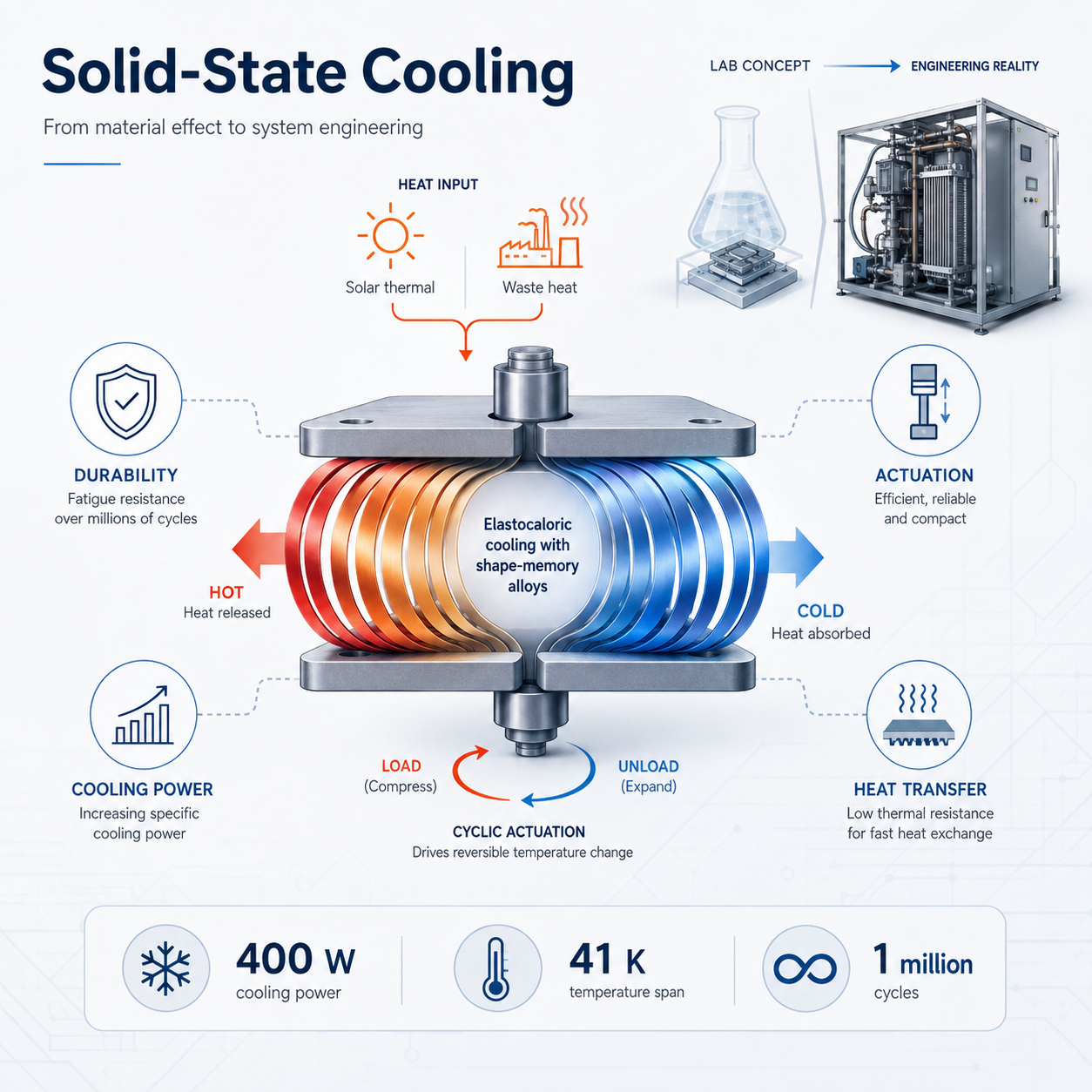
A few months ago, I wrote about #elastocaloric cooling as a credible but still immature alternative.
➡️ Two papers published in August now provide an interesting update.
The important point is not simply that performance is improving.
It is that research is beginning to address different parts of the same industrialisation problem.
✔️ A study published online in "Joule" on 17 August reports an #elastocaloric device delivering 400 W of cooling power, with a temperature span of 41 K and one million operating cycles without degradation in cooling power.
That matters because fatigue and durability remain central barriers for shape-memory alloy systems.
✔️ A second study, published in "Nature Energy" on 28 August, addresses another constraint: actuation.
#𝗘𝗹𝗮𝘀𝘁𝗼𝗰𝗮𝗹𝗼𝗿𝗶𝗰 cooling requires the material to be mechanically loaded and unloaded. This normally requires electrically powered actuators, adding size, complexity and energy consumption.
The researchers instead used a thermally activated shape-memory alloy to drive the cooling material.
The objective is particularly interesting: using heat, potentially waste heat or solar thermal energy, to produce cooling while reducing dependence on electrical actuation.
The prototype is still far from an #HVAC solution. With an external heat source, the demonstrated device-level temperature span was only 2.2 K.
➡️ But the direction is becoming clearer.
Research is moving beyond proving that #elastocaloric materials can produce cooling.
It is increasingly focusing on the system architecture required to make them usable: durability, cooling capacity, actuation and heat transfer.
➡️ Solid-state cooling should therefore not yet be considered a substitute for conventional refrigeration.
But it is becoming increasingly difficult to consider it only a laboratory curiosity.
The refrigerant transition may eventually concern more than the choice between one fluid and another.
It may also concern the technology used to generate cooling.