𝗧𝗵𝗲 𝗻𝗲𝘅𝘁 𝗿𝗲𝗳𝗿𝗶𝗴𝗲𝗿𝗮𝗻𝘁 𝗺𝗮𝗿𝗸𝗲𝘁 𝘄𝗶𝗹𝗹 𝗻𝗼𝘁 𝗯𝗲 𝗱𝗲𝗳𝗶𝗻𝗲𝗱 𝗼𝗻𝗹𝘆 𝗯𝘆 𝗿𝗲𝗽𝗹𝗮𝗰𝗲𝗺𝗲𝗻𝘁 𝘁𝗮𝗯𝗹𝗲𝘀.

For years, much of the discussion has been built around one question:
What can replace R404A, R507A, R410A or other high-GWP refrigerants?
That question remains useful.
But it is becoming too narrow.
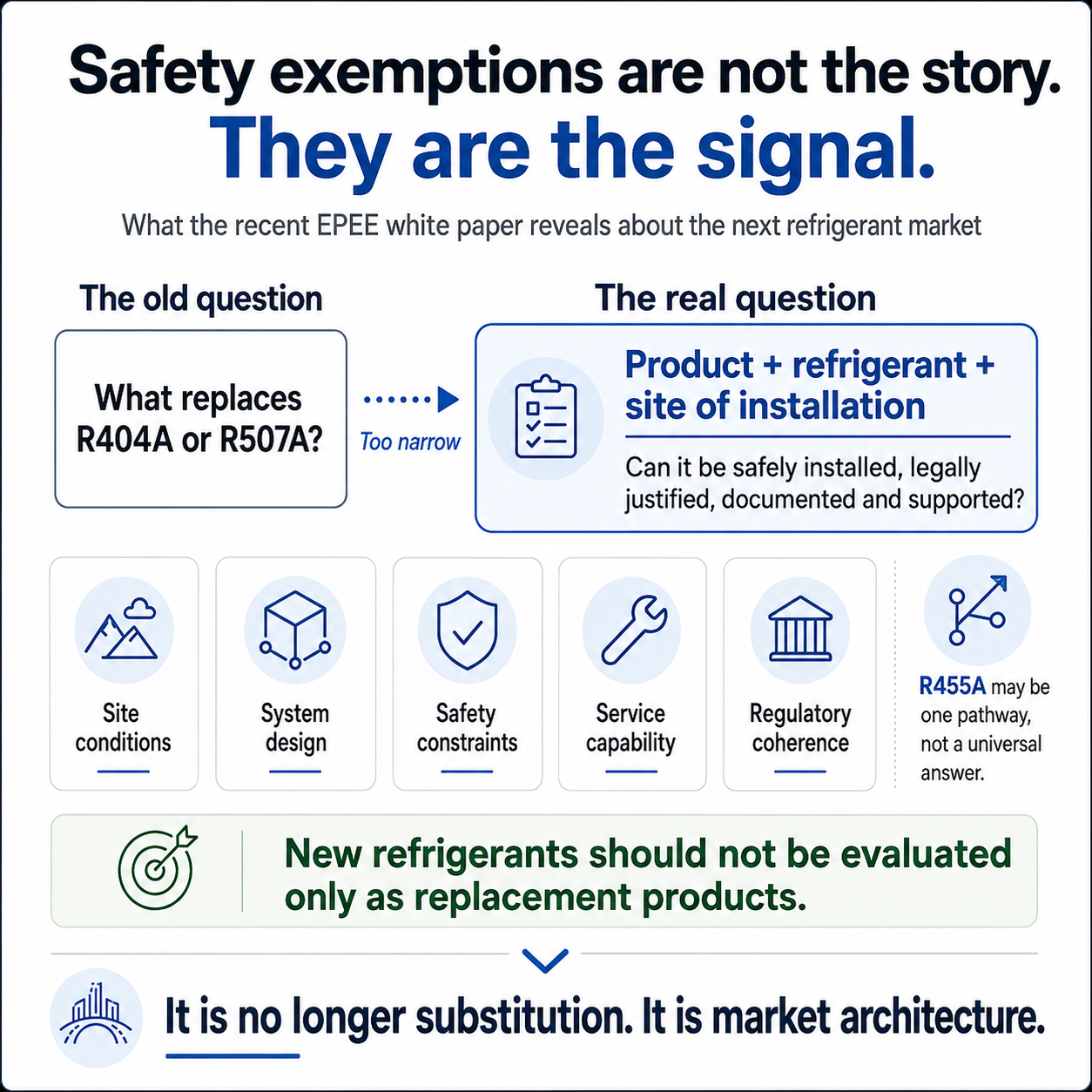
The recent EPEE white paper on safety requirements exemptions under the revised F-gas Regulation gives an important signal.
Not because exemptions should become a normal commercial pathway.
They should not.
But because they show how the transition is becoming more application-specific.
The safety exemption is not presented as a general exemption for a product category.
It is linked to a specific configuration:
product + refrigerant + site of installation.
This changes the way refrigerants should be evaluated.
The real question is no longer only:
“What replaces what?”
It is becoming:
“Where can this refrigerant, in this equipment, be safely installed, legally justified, documented and supported?”
That is a different market logic.
It means that products such as R455A should not be read only as replacements for R404A or R507A.
They should be read as possible answers inside a more segmented market, where each application requires its own technical and regulatory justification.
In this market:
▪️ recovered and regenerated refrigerants will support part of the installed base
▪️ low-GWP blends will address selected applications
▪️ natural refrigerants will expand where system design and safety conditions allow it
▪️ installers and operators will carry more documentation responsibility
▪️ service capability will become part of product viability
➡️ The next phase will not reward only the lowest GWP.
It will reward the clearest application logic.
➡️ That is no longer simple substitution.
It is market architecture.
‼️Expansion is not acceleration. It is architecture.
𝘛𝘦𝘤𝘩𝘯𝘪𝘤𝘢𝘭 𝘳𝘦𝘧𝘦𝘳𝘦𝘯𝘤𝘦: 𝘌𝘗𝘌𝘌, 𝘛𝘩𝘦 𝘚𝘢𝘧𝘦𝘵𝘺 𝘳𝘦𝘲𝘶𝘪𝘳𝘦𝘮𝘦𝘯𝘵𝘴 𝘦𝘹𝘦𝘮𝘱𝘵𝘪𝘰𝘯 𝘶𝘯𝘥𝘦𝘳 𝘵𝘩𝘦 2024 𝘳𝘦𝘷𝘪𝘴𝘦𝘥 𝘍-𝘨𝘢𝘴 𝘙𝘦𝘨𝘶𝘭𝘢𝘵𝘪𝘰𝘯, 𝘔𝘢𝘺 2026.