𝗜𝗹𝗹𝗲𝗴𝗮𝗹 𝗿𝗲𝗳𝗿𝗶𝗴𝗲𝗿𝗮𝗻𝘁𝘀 𝗱𝗼𝗻’𝘁 𝗷𝘂𝘀𝘁 𝗯𝗿𝗲𝗮𝗸 𝘁𝗵𝗲 𝗿𝘂𝗹𝗲𝘀. 𝗧𝗵𝗲𝘆 𝗰𝗮𝗻 𝗯𝗿𝗲𝗮𝗸 𝘁𝗵𝗲 𝗿𝗲𝗰𝗹𝗮𝗶𝗺𝗶𝗻𝗴 𝗰𝗵𝗮𝗶𝗻.
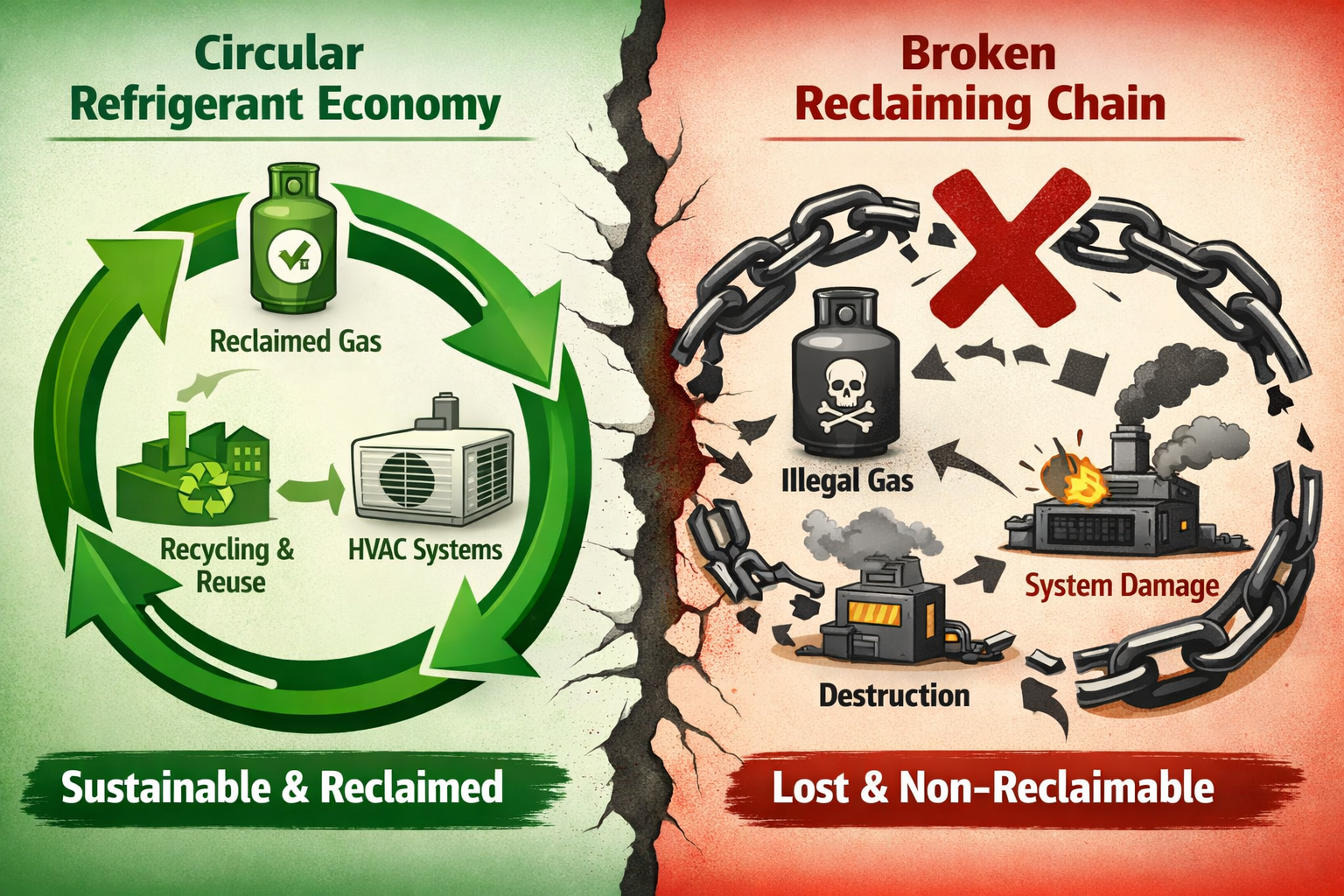

Recent seizures of illegal refrigerants in Europe show a problem that goes beyond market distortion.
In many cases, laboratory analysis after system issues reveals a critical point:
the product inside the cylinder does not correspond to what is declared.
It may be a mixture of different refrigerants, sometimes including substances already banned under the F-Gas framework.
The first risk is technical.
An uncontrolled blend is handled as if it were a standard product, but its composition, glide and behaviour may be different.
That can create malfunctions and safety risks for professionals working on the system.
But there is another consequence, less visible.
If the recovered fluid does not meet the required specifications, it cannot always be reclaimed or regenerated.
In many cases, it can only be destroyed.
This is where the damage becomes structural.
A refrigerant that cannot be reclaimed is not only a non-compliant product.
It is a lost resource.
At a time when reclaimed and regenerated refrigerants are becoming essential to support part of the installed base, every contaminated or unidentified fluid weakens the circular model the market needs.
The issue is therefore not only what enters the market illegally.
It is also what can no longer remain in the market legally.
➡️ Reclaiming depends on trust, traceability and product integrity.
Illegal refrigerants attack all three.